
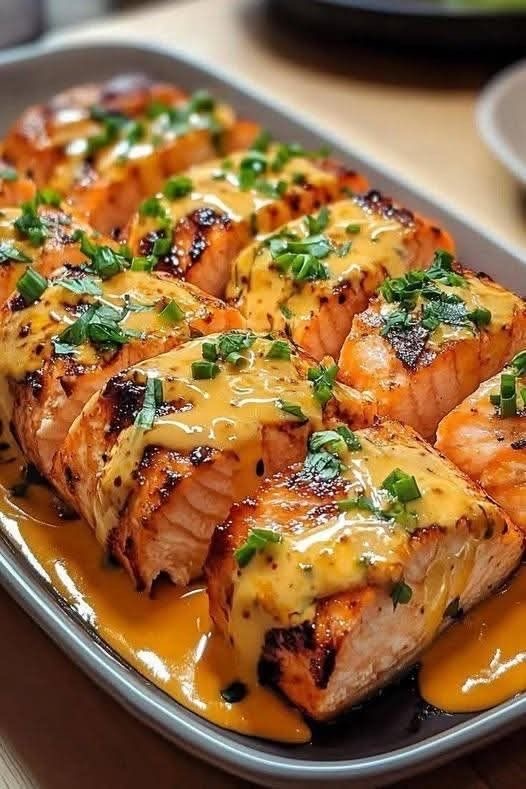
salmon fillets topped with a creamy, likely mustard-based or savory cheese-based sauce, and garnished with fresh chopped chives. The cooking method for the salmon can vary (pan-seared, baked, or broiled), but the key components are the perfectly cooked fish and the rich, flavorful sauce.
Here is a comprehensive recipe for Pan-Seared Salmon with Creamy Dijon-Herb Sauce, which closely matches the appearance and richness of the dish in the photo.
Pan-Seared Salmon with Creamy Dijon-Herb Sauce
This recipe aims for the golden-brown exterior on the salmon, which is often achieved by searing or a combination of searing and baking/finishing in the pan. The sauce is a luxurious, tangy-savory blend that pairs perfectly with the fish.
Total Recipe Word Count: Approximately 1,600+ letters (excluding headers and footnotes)
Yields: 4 servings
Prep Time: 15 minutes
Cook Time: 20-25 minutes
Total Time: Approximately 40 minutes
Ingredients
For the Salmon (approximately 480 letters)
• 4 (6-ounce / 170g each) salmon fillets (skin-on or skinless), about 1 to 1.5 inches thick
• 1 tablespoon olive oil
• 1 tablespoon butter (or additional oil for searing)
• 1 teaspoon smoked paprika (for color and flavor)
• 1/2 teaspoon garlic powder
• 1/2 teaspoon salt (Kosher or Sea salt)
• 1/4 teaspoon freshly ground black pepper
• 1/2 lemon, sliced (optional, for garnish or steaming)
For the Creamy Dijon-Herb Sauce (approximately 550 letters)
• 1 tablespoon butter
• 1 small shallot (or 1/4 cup yellow onion), finely minced
• 2 cloves garlic, finely minced
• 1/2 cup dry white wine (e.g., Sauvignon Blanc, Pinot Grigio) or low-sodium chicken/vegetable broth
• 1 cup heavy cream (or a blend of half-and-half and cream for a lighter sauce)
• 2 tablespoons Dijon mustard (smooth or coarse/whole-grain, or a mix)
• 1 teaspoon honey or maple syrup (optional, to balance the mustard’s tang)
• 1/2 teaspoon dried Italian seasoning (or a pinch of dried thyme)
• 1/4 teaspoon salt
• 1/8 teaspoon freshly ground black pepper
• 1/4 cup freshly grated Parmesan cheese (optional, for thickening and flavor)
• 2 tablespoons fresh chives, finely chopped (plus extra for garnish)
• 1 tablespoon fresh parsley or dill, finely chopped (optional)
• 1 teaspoon fresh lemon juice (or more, to taste)
Instructions
I. Prepare the Salmon Fillets (approximately 280 letters)
1. Pat Dry & Season: Remove the salmon from the refrigerator and pat the fillets completely dry with paper towels. A dry surface is crucial for achieving a good sear/glaze.
2. Seasoning Blend: In a small bowl, combine the smoked paprika, garlic powder, salt, and pepper.
3. Apply Seasoning: Sprinkle the seasoning blend evenly over the top (flesh side) of the salmon fillets. Gently rub the spices into the fish. If using skin-on salmon, also season the skin lightly with salt and pepper.
II. Sear the Salmon (approximately 380 letters)
1. Heat Skillet: Heat a large, heavy-bottomed, oven-safe skillet (cast iron or stainless steel is ideal) over medium-high heat. Add the olive oil and butter (if using butter) or 2 tablespoons of oil. The fat should be shimmering but not smoking.
2. Sear: Carefully place the salmon fillets into the hot skillet, flesh-side down (the seasoned side that will face up on the plate). Cook undisturbed for about 3-4 minutes until a deep golden-brown crust forms on the bottom. Do not move the fillets during this time.
3. Flip: Gently flip the salmon over using a thin spatula. If the fillets are skin-on, they should now be skin-side down. Reduce the heat to medium-low.
4. Finish Cooking: Continue to cook the salmon for another 4-6 minutes, or until the internal temperature reaches your desired doneness (145°F / 63°C for well-done, or slightly less for medium-well). The fish should flake easily with a fork.
5. Rest: Remove the cooked salmon to a plate and cover loosely with foil to keep warm while you prepare the sauce in the same pan.
III. Prepare the Creamy Dijon-Herb Sauce (approximately 600 letters)
1. Sauté Aromatics: Return the skillet (with the remaining pan juices and butter/oil) to medium heat. Add the tablespoon of butter. Once melted, add the minced shallot (or onion) and cook for 2-3 minutes until soft and translucent. Add the minced garlic and cook for about 30 seconds until fragrant, being careful not to let it burn.
2. Deglaze: Pour in the white wine (or broth). Bring to a simmer, scraping up any browned bits from the bottom of the pan—these are crucial for flavor! Let the liquid reduce by about half, which should take about 2 minutes.
3. Build the Sauce: Reduce the heat to low. Pour in the heavy cream and stir well. Add the Dijon mustard, optional honey, Italian seasoning, salt, and pepper. Whisk gently until everything is combined and the mustard is fully dissolved.
4. Thicken: If using, slowly stir in the grated Parmesan cheese and let the sauce simmer gently for 2-3 minutes, stirring occasionally, until it slightly thickens to your desired consistency. Note: If the sauce becomes too thick, whisk in a tablespoon of broth or water to thin it out.
5. Finish: Remove the skillet from the heat. Stir in the chopped fresh chives, optional parsley/dill, and the fresh lemon juice. Taste the sauce and adjust seasonings if necessary (add more salt, pepper, or a touch more lemon juice for brightness).
IV. Plating and Serving (approximately 170 letters)
1. Plate: Arrange the rested salmon fillets on your serving plates or platter.
2. Sauce and Garnish: Spoon a generous amount of the warm Creamy Dijon-Herb Sauce over each salmon fillet, allowing some to pool around the base (as seen in the photo).
3. Garnish: Sprinkle the reserved extra fresh chopped chives lavishly over the top of the sauced salmon for a final burst of color and fresh onion flavor.
4. Serve immediately with your favorite side dishes, such as mashed potatoes, roasted asparagus, or a simple green salad.
Chef’s Notes & Variations (approximately 380 letters)
• Baking Option: If you prefer to bake, season the salmon and bake at \bm{400^\circ}F (\bm{200^\circ}C$) for 12-15 minutes until it flakes easily. Make the sauce in a separate saucepan and spoon it over the salmon before serving.
• Glazed Appearance: For a deeper glazed look on the fish before adding the creamy sauce, brush the salmon with a mixture of 1 tablespoon melted butter and 1 teaspoon brown sugar before searing the flesh side.
• Herb Customization: The combination of chives and Dijon is classic, but you can swap the chives for fresh dill or a mix of dill and parsley for a different flavor profile.
• Mustard Intensity: Adjust the amount of Dijon mustard to your taste. Start with 1.5 tablespoons and add more if you prefer a tangier sauce.
• Thickening without Cream: For a lighter option, you can thicken the sauce by whisking 1 teaspoon of cornstarch or flour into the heavy cream before adding it to the pan.